El proyecto asociado a este seminario ha finalizado
Abajo podrá encontrar todas las actividades realizadas en este seminario y en este proyecto.

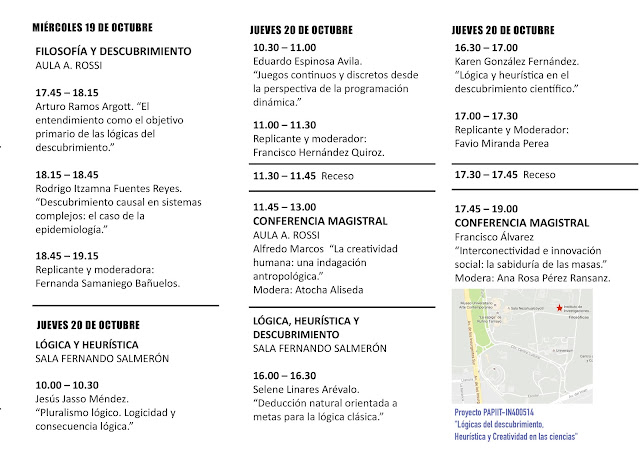
2016: Taller 19 y 20 de octubre: Lógicas del descubrimiento y Creatividad en las Ciencias
Consulta las presentaciones - o - Descarga el programa con enlaces a las presentaciones
Puedes ver las fotos del Taller aquí
Descarga el cuadernillo de resúmenes en PDF
Ponencias Magistrales:
Fernando Broncano
Alfredo Marcos
Francisco Álvarez / Interconectividad e innovación social

Mapa del lugar
Suspensión de actividades del seminario para el semestre 2016-2
Le informamos a la comunidad que el Seminario de Lógica y Heurística suspenderá sus sesiones quincenales para el semestre 2016-2 (enero de 2016 a julio de 2016).
Sin embargo, seguiremos utilizando este medio para dar aviso de cualquier evento, información o recurso en general concerniente al seminario.
La irrupción de las masas y la sabiduría colectiva
Ponente: J. Francisco Álvarez (Universidad Nacional de Educación a Distancia)
Fecha: viernes 18 de septiembre de 2015, 12:00 horas.
Lugar: Sala de Investigadores Fernando Salmerón, Instituto de Investigaciones Filosóficas, UNAM.
IAD y las inconsistencias en juegos argumentativos*
Ponente: Matthieu Fontaine (UNAM-IIF)
Fecha: 25 de mayo, 12 hrs
Lugar: Sala de Investigadores Fernando Salmerón, Instituto de Investigaciones Filosóficas, UNAM.
Resumen:Las lógicas paraconsistentes son lógicas que no soportan la explosión. Estas lógicas presentan un cierto interés para el análisis del discurso científico y la argumentación en general. Efectivamente, inconsistencias pueden aparecer en teorías o en el curso de argumentación, y eso no es una razón suficiente para abandonar la misma teoría o dejar el proceso de argumentación. Tampoco son razones suficientes para inferir cualquier cosa. ¿Cómo podemos adaptar el discurso científico y la argumentación a la aparición de inconsistencias? El objetivo de esta ponencia consiste en la presentación de IAD (Inconsistency Adaptive Dialogical Logic), una lógica paraconsistente no monotónica, basada en la lógica dialógica paraconsistente de Rahman y Carnielli y las lógicas adaptivas de Batens. Además de presentar las reglas de IAD, discutiré sus ventajas respecto a las lógicas dialógicas paraconsistentes así como de la lógica inconsistente adaptativa.
Referencias
- Diderik Batens. 2000. « A survey of inconsistency-adaptive logics ». In Batens, Priest, and Van Bendegem (eds), Frontiers of Paraconsistent Logic. Baldock: Research Studies Press, King’s College Publications: 49-73.
- Sahid Rahman and Walter Carnielli. 2000. « The dialogical approach to paraconsistency ». Synthese, 125(1-2):201-232.
* Esta presentación está basada en un trabajo realizado con Mathieu Beirlaen (Ruhr-Universität Bochum) actualmente en proceso de evaluación.
Referencias
- Diderik Batens. 2000. « A survey of inconsistency-adaptive logics ». In Batens, Priest, and Van Bendegem (eds), Frontiers of Paraconsistent Logic. Baldock: Research Studies Press, King’s College Publications: 49-73.
- Sahid Rahman and Walter Carnielli. 2000. « The dialogical approach to paraconsistency ». Synthese, 125(1-2):201-232.
* Esta presentación está basada en un trabajo realizado con Mathieu Beirlaen (Ruhr-Universität Bochum) actualmente en proceso de evaluación.
How to prove it in Natural Deduction: A Tactical Approach*
Ponente: Selene Linares (UNAM-IIMAS)
Fecha: 11 de mayo, 12 hrs
Lugar: Sala de Investigadores Fernando Salmerón, Instituto de Investigaciones Filosóficas, UNAM.
Resumen: In this talk I will present the content of the paper "How to prove it in Natural Deduction: A Tactical Approach" by Favio E. Miranda-Perea, Atocha Aliseda and me. The motivation for this paper comes out of our experience with teaching natural deduction (ND) and with the way this formal system is implemented by the Coq proof assistant, namely by means of so-called tactics, which are heuristics that transform a goal formula into a sequence of subgoals whose provability implies that of the original formula. We aim at capturing some of these tactics into a system of ND for minimal logic. Our goal is twofold: formal and didactic. The former delivers a formal system with its underlying heuristics to build proofs, which in turn serves our latter purpose, that of making an ideal system for the teaching of ND at an undergraduate level in a computer science program.
Presentación.
* Esta charla será presentada en el 4th International Conference on Tools for Teaching Logic en Rennes, Francia.
Presentación.
* Esta charla será presentada en el 4th International Conference on Tools for Teaching Logic en Rennes, Francia.
Notes on the No Alternatives Argument
Ponente: Philiphe van Basshuysen*
Fecha: 27 de abril, 12 hrs
Lugar: Sala de Investigadores Fernando Salmerón, Instituto de Investigaciones Filosóficas, UNAM.
Resumen: In a recent paper (2015), Dawid, Hartmann and Sprenger give a Bayesian argument in favour of the No Alternatives Argument: the conclusion from a lack of alternatives to a scientific theory to the truth of that theory. If valid, this would constitute a proof for the possibility of non-empirical theory confirmation. In this paper I argue that their "proof" begs the question.
I challenge the validity of the argument in two steps. I first give a principled line of reasoning concerning one critical assumption of their analysis, namely that the probability of a scientific hypothesis depends on the number of its alternative theories. I claim that arguing for this assumption implies either a regress to non-empirical theory confirmation, or a dubious application of the Principle of Indifference. In either case, the assumption stands on shaky grounds. In the second step, I give a counterexample to the assumption in order to show that it must indeed not be expected to hold.
I conclude with a more general claim. I claim that Bayesian analyses, and particularly the use of Bayesian nets, are “dangerous” in that they may entice one to be careless about implicit assumptions about probabilistic (in)dependencies, and how they support normative claims. I intend to broaden this investigation by more case studies and, finally, a general line of reasoning as to the boundaries of normative Bayesian analyses.
Lecturas previas:
Dawid, Hartmann y Sprenger
Basshuysen
Presentación.
*Debido a causas de fuerza mayor, la ponente original que presentaría en esta fecha (Ana Ponce) no podrá asistir al seminario y su charla quedará pendiente para un sesión posterior. Lamentamos los inconvenientes.
I challenge the validity of the argument in two steps. I first give a principled line of reasoning concerning one critical assumption of their analysis, namely that the probability of a scientific hypothesis depends on the number of its alternative theories. I claim that arguing for this assumption implies either a regress to non-empirical theory confirmation, or a dubious application of the Principle of Indifference. In either case, the assumption stands on shaky grounds. In the second step, I give a counterexample to the assumption in order to show that it must indeed not be expected to hold.
I conclude with a more general claim. I claim that Bayesian analyses, and particularly the use of Bayesian nets, are “dangerous” in that they may entice one to be careless about implicit assumptions about probabilistic (in)dependencies, and how they support normative claims. I intend to broaden this investigation by more case studies and, finally, a general line of reasoning as to the boundaries of normative Bayesian analyses.
Lecturas previas:
Dawid, Hartmann y Sprenger
Basshuysen
Presentación.
*Debido a causas de fuerza mayor, la ponente original que presentaría en esta fecha (Ana Ponce) no podrá asistir al seminario y su charla quedará pendiente para un sesión posterior. Lamentamos los inconvenientes.
Suscribirse a:
Entradas (Atom)